
TAI CHI MIGHT BE EXACTLY WHAT YOU’VE BEEN MISSING
By the time most people think about slowing down, their body has already been shouting at them for a while.
Tight shoulders that won’t drop. A jaw that stays clenched long after the stressful moment has passed. That wired but exhausted feeling in the evening where you finally sit down, yet your mind keeps running laps. You’re “resting,” but nothing inside you actually feels rested.
Most people come to Tai Chi thinking it’s about flexibility or balance. Those things do improve, but they’re not the real reason people stay. What Tai Chi actually offers is a way back into your body when your nervous system has forgotten how to switch off.
If you live with anxiety, low mood, overwhelmed, or chronic pain, you’ll know this pattern well. Your thoughts race. Your breathing stays shallow. Your muscles brace as if you’re constantly preparing for something to go wrong. Over time, that state becomes normal. You might not even notice how tense you are until someone points it out or your body starts protesting in louder ways.
Tai Chi doesn’t ask you to force relaxation. It doesn’t tell you to empty your mind or push through discomfort. Instead, it gives your body a different experience and lets your nervous system do the rest.
The movements are slow and deliberate, but not in a fragile way. They’re steady. Grounded. Intentional. You move with breath rather than against it. Your attention drops out of your head and into your feet, your hands, your centre. The thinking mind softens because it has something simple and meaningful to focus on.
For many people, this is the first time in years they’ve felt present without trying.
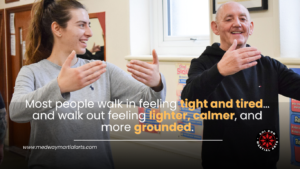
One of the most common things students say after class is how surprised they are by how calm they feel. Not sleepy. Not spaced out. Calm in a way that feels stable and clear. The kind of calm that makes everyday problems feel a little more manageable rather than overwhelming.
That’s not an accident. Slow, controlled movement combined with deep, natural breathing sends a clear message to your nervous system that it’s safe to stand down. Heart rate lowers. Muscles release. Breathing deepens on its own. Over time, your body learns that it doesn’t have to stay on high alert.
This is especially important for anyone dealing with anxiety or mental health challenges. When your mind feels busy or intrusive, sitting still to meditate can sometimes feel impossible. Tai Chi gives you movement without impact, structure without pressure, and space without silence. You’re not asked to “fix” your thoughts. You’re simply guided back into the body, where regulation begins.
It’s also an ideal practice for those who need something gentle. No jumping. No rushing. No strain on joints. Tai Chi meets you exactly where you are. Whether you’re managing pain, fatigue, stress, or just a deep sense of being worn down, the practice adapts to you, not the other way around.
There’s something empowering about that.
Over time, students notice changes beyond the class itself. Better sleep. Less physical tension. A stronger sense of balance, both physically and emotionally. A feeling of being more grounded when life gets noisy. You start to catch yourself breathing more deeply during the day. Your shoulders drop without being reminded. Your reactions soften.
Tai Chi doesn’t promise instant transformation. What it offers is something more sustainable. A way to retrain your body to feel safe, steady, and supported again.
If your body feels tired but your mind won’t rest, if high impact exercise feels like too much, or if you simply want a calmer way to move and reconnect, Tai Chi might be exactly what you’ve been missing.
Not as an escape from life, but as a way to meet it with a little more ease.